Key Takeaways
- The device is only one part of the purchase. Storage, training, replacement quills, and a return-to-service process determine whether a tire deflation system is ready when your team needs it.
- Controlled deflation is different from a blowout. These tools vent air to reduce a fleeing vehicle’s speed, and the result varies based on the tire, load, speed, and contact angle.
- Choose a system based on your patrol environment. Urban intersections, highway shoulders, and rural two-lane roads have different storage and roadway coverage needs.
- Match the device to your department’s policy. What a device can do and what your policy permits may be different, so choose equipment that supports the uses your policy already allows.
Choosing between Stop Sticks, spike strips, or a Stinger system involves more than comparing how effectively each device punctures a tire. They all can. You also need to consider how officers will carry the device in the unit, deploy it on the roadway they patrol, recover it safely, and return it to service. “Police tire spikes” is often used as a catch-all term, but controlled-deflation systems, traditional spike strips, and Stinger configurations differ in storage, deployment speed, road coverage, and recurring consumable cost.
In this law enforcement buying guide, we cover duty-rated pursuit-intervention equipment only, not the off-road air-down deflators sold for airing tires down on trails. We explain how these devices work, how Stop Sticks compare with spike strips and the Stinger Spike System, what officers need to know about training and deployment safety, and which procurement details affect how well a system fits patrol operations.
What are Police Tire Deflation Devices Built to Do?
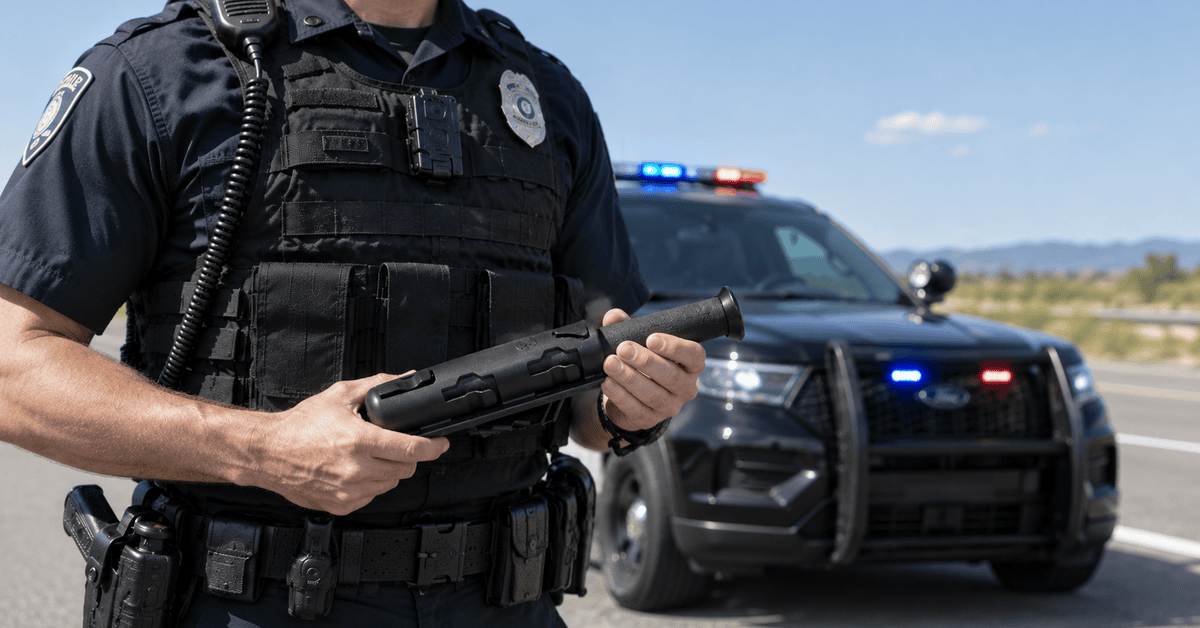
A law-enforcement tire deflation device is a pursuit-intervention tool that punctures one or more tires on a target vehicle so that air leaves the tire in a controlled way. The category includes Stop Sticks, spike strips, Stinger-style systems, and related police tire deflation devices used by law enforcement as a pursuit termination option.
Don’t confuse these devices with off-road or overlanding tire deflators, which lower tire pressure through the valve stem to improve traction on trails and gravel. Police tire spikes and Stop Sticks are duty-rated law enforcement tools designed for roadway deployment against fleeing vehicles or assaultive vehicle threats, as permitted by agency policy.
When purchasing a tire deflation system, the device itself is only one consideration. A deployable system includes the unit, replacement quills or spikes, a carry case or storage method, officer training, visibility support, lighting for night use, gloves for handling, and a return-to-service process after deployment. Agencies outfitting patrol units can evaluate the device alongside broader law enforcement equipment to account for storage, safety, and training from the start.

Stop Sticks vs Spike Strips vs Stinger Systems
Stop Sticks, traditional spike strips, and Stinger systems fall in the same general category but differ in how officers use them in the field. Compare them based on storage, deployment, roadway coverage, and the process for restoring each system to service after contact.
| System type | Typical fit | Deployment considerations | Procurement considerations |
|---|---|---|---|
| Stop Sticks | Agencies that want a lightweight, controlled-deflation tool with familiar law-enforcement brand recognition | Placement, officer position, retrieval, and quill replacement should be built into training | Plan for replacement quills, carry method, storage, and unit-level readiness after deployment |
| Traditional spike strips | Departments that want a recognizable pursuit-intervention format with roadway coverage as a primary consideration | Bulk, handling, roadway placement, and recovery vary widely by design | Compare storage footprint, repairability, consumables, and compatibility with patrol vehicle space |
| Stinger Spike System | Agencies comparing different deployment lengths and roadway conditions | Length selection affects lane coverage, positioning, and retrieval plan | Evaluate available configurations, replacement components, training burden, and carry setup |
Where Stop Stick Fits for Agencies Comparing Final Options
Stop Stick is a well-known brand in law enforcement tire deflation, offering products designed for lightweight deployment, controlled deflation, and patrol-ready pursuit intervention. For agencies already familiar with the brand, the next step is determining whether Stop Stick products and replacement components best fit the department’s deployment needs.
Columbus Supply carries Stop Stick as a professional-grade law enforcement product line for agencies, officers, and procurement teams that want an established brand from a distributor that can also provide supporting equipment.
Shop Stop Stick products directly and then find the storage, gloves, visibility equipment, and other field-use gear needed for deployment.
Stop Stick may be a good fit for agencies that prioritize:
- Compact patrol carry: the device can be stored in a cruiser while remaining accessible when officers need it.
- Controlled-deflation performance: the system is designed to release air from the tires at a controlled rate rather than causing a sudden blowout.
- Replaceable consumables: agencies can incorporate replacement quills and related parts into their regular restocking process.
- Repeatable training: officers can train on a consistent deployment method so that they are familiar with the device when they need to use it.
- Simple product sourcing: procurement teams can buy the device and supporting equipment through one law enforcement supplier rather than sourcing each item separately.
Stop Stick may not be the best fit for every patrol environment. If the priority is a particular deployment footprint or longer roadway coverage, you should also compare Stinger or other spike systems. Base your comparison on the patrol environment, not brand familiarity alone.
Stinger Spike Systems and Roadway Coverage
When comparing the Stinger Spike System with Stop Sticks, agencies should pay close attention to deployment length and roadway coverage. Different lengths are suited to different road conditions, allowing agencies to choose a system that better matches the roads they patrol.
A longer system helps cover a broader lane area but may require more storage space and affect how officers deploy and retrieve it. A shorter setup is easier to carry but may demand more precise placement. The right length depends on where the system will be deployed, whether on highways, urban streets, rural roads, parking areas, or planned containment positions.
When comparing a Stinger Spike System with Stop Stick, procurement teams should ask:
- Where will the device usually be carried in the unit?
- How quickly can an officer access it without unpacking other equipment?
- How much roadway does the system need to cover in common deployment locations?
- How is the system retrieved after deployment?
- What parts need to be replaced after contact with a tire?
- How will spares be stored and tracked?
The answers differ among patrol, traffic enforcement, and specialized units. A traffic unit working high-speed corridors may need a different configuration than a patrol car assigned to dense streets with short blocks and no shoulder.
Buying Guide for Agency Procurement
Evaluate a professional-grade tire deflation device as you would other duty equipment. The system needs to fit the agency’s vehicles, roads, training program, replacement-part process, and officer safety practices.
Start with Patrol Environment
Urban agencies deal with intersections, parked vehicles, medians, sidewalks, short sightlines, and pedestrians. Highway units operate around wider lanes, faster closing speeds, shoulders, ramps, and divided roadways. Rural agencies face two-lane roads, gravel shoulders, limited lighting, and long response distances.
These conditions factor into your choice. A device that stores neatly but lacks the roadway coverage the agency needs can create placement problems. A longer system that covers a wide lane can be harder to store or retrieve from a smaller patrol vehicle. This makes it essential to compare tools based on real deployment locations rather than an ideal training lot.
Plan the In-Vehicle Setup
If the device isn’t accessible, it won’t get used consistently. Decide where the system will ride in the vehicle, how it’s secured, and whether officers can reach it quickly without moving bags, cones, long guns, medical gear, or traffic equipment.
Vehicle tool mounts and brackets can keep the device in a designated location. Storage planning should also account for spare quills, gloves, chem lights, and any inspection tags the agency uses. Agencies purchasing law enforcement tools should treat the tire deflation system as part of the patrol vehicle layout, not a loose item stored wherever there is space.
Evaluate Return-to-Service Requirements
After deployment, the unit may need inspection, cleaning, quill or spike replacement, repacking, and restocking. A system with inexpensive, readily available consumables still creates downtime if the agency has no restock process. Similarly, a durable device still sits out of service when spare components aren’t kept on hand in sufficient quantities.
One procurement detail worth raising early if any part of the purchase runs on federal preparedness grant money: DHS lists tire deflation devices under Authorized Equipment List number 14SW-01-WALL, in AEL category 14 (Physical Security Enhancement Equipment). Whether a specific device qualifies under a specific grant is a question for your grant administrator rather than a spec sheet, but the AEL entry is where that conversation starts.
Define who inspects the unit after use, where replacement parts are stored, how many spares each vehicle or station keeps, and when a device comes out of service. These decisions depend on agency size and usage pattern and should be addressed before purchase.

How to Choose a Tire Deflation Device by Patrol Scenario
When choosing your device, start with where and how officers will use it. A department covering a dense downtown grid needs a different setup than an agency covering long highway corridors. In the same way, a rural unit with limited backup has different storage and deployment needs than a traffic unit working multi-lane roads.
| Patrol scenario | What to prioritize | Questions to ask before buying |
|---|---|---|
| Urban streets | Compact carry, fast access, controlled placement, visibility around traffic and pedestrians | Can officers deploy without stepping into poor sightlines? Can the device be recovered quickly? |
| Highway or divided roadway | Roadway coverage, communication with pursuing units, lighting, shoulder positioning | Does the system fit common lane widths and shoulder conditions? How is the deployment point marked at night? |
| Rural roads | Storage reliability, low-light support, simple retrieval, spare consumables carried in the unit | Can the officer deploy and recover with limited backup? Are replacement parts available without delay? |
| Pre-planned containment | Policy alignment, staging method, officer positioning, accountability for placed devices | Does agency policy authorize the use case? How are staged devices tracked and removed? |
Starting with the patrol scenario also keeps a single feature from dominating the decision. Light weight, longer coverage, brand familiarity, and replacement-part availability are all worth considering, but their importance depends on the agency’s deployment needs.
Shop Stop Stick Products for Patrol-Ready Deployment
For agencies comparing tire deflation devices, Stop Stick offers a controlled-deflation product line that may already be familiar to many officers. Agencies should consider the product as part of a complete deployment plan that includes storage, training, replacement quills, visibility, lighting, gloves, and return-to-service procedures.
If your department is evaluating Stop Sticks for sale or building out a patrol-ready pursuit-intervention kit, shop Stop Stick products at Columbus Supply. You can also browse the broader law enforcement categories for the supporting gear needed to keep the device accessible, deployable, and ready for the next shift.
Frequently Asked Questions
Stop Sticks are a branded controlled-deflation system with a specific quill-based design, while spike strips is the broader term people use for tire-puncturing roadway devices. In practice, the difference shows up in how the unit is carried, deployed, and restocked after use.
Police tire spikes are designed to puncture and vent air in a controlled way rather than shatter a tire all at once. The vehicle loses pressure and becomes harder to keep moving at speed, but the result still depends on the tire, vehicle load, and how the device is contacted. That is why the same tool can behave differently across different vehicles and road conditions.
Agencies should look at the full system, not just the device itself. Storage in the patrol vehicle, replacement quills or other consumables, training support, and how fast the unit can return to service after deployment all affect whether the purchase fits daily operations. Roadway coverage and deployment style matter too, especially if the device will be used on highways or in narrow urban settings.
A Stinger spike system can make sense when deployment length and roadway coverage are the main buying considerations. If the agency wants different lengths for different road conditions, that flexibility may matter more than brand familiarity alone. The best fit depends on where officers will actually deploy the device and how much storage space the unit has.
Some agencies address preemptive deployment in policy, while others limit use to active pursuit situations. The equipment itself does not create permission; local policy, training, and legal authority do.
Officers usually need more than the device itself. Gloves, high-visibility apparel, scene lighting, chem lights or snaplights, spare consumables, and a secure storage method all help the system work in the field and return to service quickly. If the gear is split across different compartments or units, the device is harder to deploy under pressure.