Key Takeaways
- Backboards remain extrication and movement tools, not routine transport surfaces. The 2013 NAEMSP/ACS-COT position statement found little proven immobilization benefit; follow the medical director’s protocol.
- Molded polyethylene is a common choice for EMS fleets: nonporous, easy to decontaminate and often radiolucent. Foam-filled models provide buoyancy; folding metal boards prioritize storage over imaging.
- Check manufacturer specs, not catalog photos. Adult boards are commonly around 72 x 16 inches; verify capacity, handholds, restraint points, and compartment fit.
- Standardize compatible boards, straps, and head immobilizers across units to simplify training and spare-part inventory.
- Use a scoop for pickups requiring minimal rolling, a vacuum mattress for extended support, and a rigid board for rapid movement or specialized rescue.
Replacing EMS backboards requires separating movement needs from routine transport. Municipal ambulances may need a standard long board, water rescue teams need buoyancy and visibility, and industrial teams may prioritize compact storage. The right mix depends on call profile, access constraints, and spinal motion restriction protocols.
In this guide, we compare board types, materials, specifications, and restraintsto help you choose the right equipment for the situations your team encounters.
What Is an EMS Backboard Used for Today?
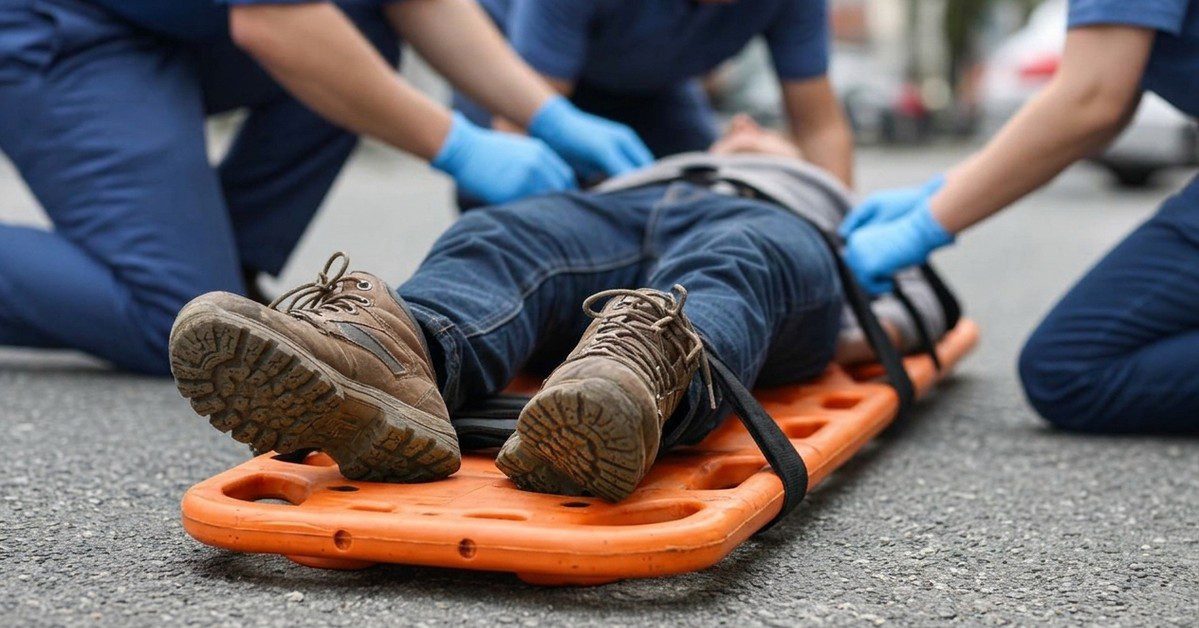
An EMS backboard is a rigid patient movement platform. Crews use it for extrication, lifting, carrying, water rescue, transfers, and selected spinal precaution scenarios under local protocol.
The names vary by agency and catalog. Long spine board, long backboard, LSB, spine board, and spine board stretcher usually describe the same device: a flat, full-length board with handholds around the perimeter and strap points or pins for securing the patient package.
Boards bridge spaces a cot cannot reach: vehicles, stairs, uneven ground and pool decks. They also support transfers onto a cot, litter, or rescue system.
The clinical role has changed, though. The joint NAEMSP and ACS-COT position statement, EMS Spinal Precautions and the Use of the Long Backboard, published in Prehospital Emergency Care in 2013, states that the benefit of long backboards for spinal immobilization is largely unproven and that their use during transport use should be judicious. Spinal precautions can still include a collar, secure cot placement, minimal patient movement, and in-line stabilization during transfers, with or without a board under the patient.
The Best EMS Backboards for Specific Jobs
| Board type | Typical role | Who usually buys it | Columbus Supply example |
|---|---|---|---|
| Adult long spine board | General EMS movement, extrication, transfer, and rescue packaging | Municipal EMS, fire departments, rescue squads, industrial first aid teams | Junkin Safety Plastic Backboard |
| Pediatric spine board | Child-sized patient packaging where adult board geometry is not a good fit | EMS agencies, pediatric transport teams, schools, venues, lifeguard operations | Kemp USA Pediatric Spineboard |
| Adult/child combo board | Fleet simplification when one board must support multiple patient sizes | Ambulances with limited storage, volunteer departments, standby EMS | Kemp USA 2-in-1 Combo Spineboard |
| Folding backboard | Compact storage and tight-access rescue movement | Industrial response, confined-space teams, rescue trucks with crowded compartments | Junkin Safety Folding Plastic Backboard |
| Short spine board or KED | Seated extrication and limited-space patient stabilization before movement | EMS and fire/rescue agencies handling vehicle extrication | Kemp USA KED |
| Aquatic spine board | Water lift-out, pool rescue, surf rescue, and shoreline movement | Lifeguards, aquatic facilities, water rescue teams, parks departments | Kemp USA EG Aquatic Spineboard Kit |
The short spine board and the KED deserve their own note. They’re seated-extrication tools used when patient position, vehicle geometry, or access makes a full-length board impractical at the start of the move. Once the patient is free, the crew still needs a movement or transport plan that follows local protocol, which may involve a long board, a scoop, or the cot.
Why EMS Moved Toward Spinal Motion Restriction
Routine backboard transport has declined because prolonged use can cause discomfort without a well-established immobilization benefit.
Spinal motion restriction, or SMR, is the broader practice of minimizing unnecessary movement while choosing the right device for the patient, mechanism, setting, and transport plan. It doesn’t mean abandoning spinal precautions. The 2014 resource document by White, Domeier, and Millin in Prehospital Emergency Care supports the same shift: a patient can receive spinal precautions without automatically remaining on a long board during transport.
The evidence summarized in Bryan Bledsoe’s EMS World article, “The Evidence Against Backboards”, is specific. A 1994 volunteer study found that all 21 subjects developed pain within 30 minutes on a backboard. A 1996 study by Chan found that backboard patients were 3.1 times more likely to report symptoms than patients on a vacuum mattress. A 1999 study by Totten and Sugarman measured roughly a 15 percent drop in respiration under immobilization.
The operational implication is selective use: a board may be appropriate for extrication and transfer, while a cot or alternative device may be preferable once the patient is free of the immediate hazard.
Follow your medical director’s protocol; purchasing guidance doesn’t determine clinical indications.
Why Agencies Still Buy Backboards
Agencies retain boards as ready-to-deploy equipment for patient movement when a cot isn’t yet accessible.
Rescue-unit requirements may differ from ambulance equipment: flotation, compact storage, or integration with a litter can influence the buying decision. Consider how the board will be used before assigning it to an apparatus.
Columbus Supply lists backboards among essential ambulance equipment. Agencies outfitting fire engines or specialty rescue vehicles can also browse fire rescue backboards.
Materials Change Cleaning, Buoyancy, Weight, and Imaging
Material affects decontamination, flotation, handling weight, and imaging compatibility.
Plastic boards became the standard because they’re easier to decontaminate than wood and can be made for X-ray translucency. One-piece polyethylene boards are a common choice: durable, nonporous, and straightforward to clean. Foam-filled plastic boards can provide buoyancy for aquatic use. Lightweight composite and polycarbonate-style boards can reduce carry weight and often float, depending on the model.
Wood still turns up in legacy fleets and training rooms. It’s harder to decontaminate and lacks the cleaning and imaging advantages of a modern board. Aluminum folding boards address a storage problem, but buyers need to consider the metal when imaging compatibility is a requirement.
| Material or construction | Field advantage | Buyer watch point | Example fit |
|---|---|---|---|
| One-piece molded polyethylene | Durable, nonporous, common fleet standard | Confirm weight, capacity, and strap compatibility by model | Municipal EMS and fire/rescue |
| Foam-filled polyethylene | Buoyancy for water rescue | Confirm flotation design and included aquatic accessories | Pool, surf, marina, and shoreline response |
| Lightweight composite or polycarbonate-style board | Lower handling weight and field portability | Verify rated capacity and compatibility with straps and head blocks | Services prioritizing lighter board handling |
| Aluminum folding construction | Compact storage and specialty access | Confirm imaging limits and hinge inspection process | Confined-space and industrial response |
| Wood | Legacy familiarity and training use | Harder to decontaminate; less suitable as a modern fleet standard | Training inventory or replacement-only situations |
Imaging compatibility is another consideration. A board that stays under a patient during facility transfer or imaging procedures should be selected with radiolucency and hardware layout in mind. Pins and other metal components can appear on imaging, which is why a model like the Ferno NAJO Lite 0-pin backboard may appeal to buyers looking for a low-metal or no-pin configuration.
For lightweight and floating options, compare the Rescue Tech Lightweight Polycarbonate Backboard with standard plastic boards from Junkin Safety. Check the product page and the manufacturer’s spec sheet before selecting a board for an application with specific weight-capacity or imaging requirements.
The Specs That Decide Whether a Board Can Be Standardized
Compare size, rated capacity, weight, handholds, restraint points, head-block fit, storage footprint, and flotation against your agency’s requirements.
Standardization is where a small detail can become a daily operating problem. A board that technically works can still frustrate crews if the handholds don’t line up for team carries, the pins don’t match the strap system, or the board won’t fit properly in the compartment where it’s stored.
| Spec | What to look for | Operational consequence |
|---|---|---|
| Dimensions | Common adult boards are in the 72 x 16 inch class, with model-specific thickness | Controls storage fit, patient fit, and compatibility with accessories |
| Weight | Compare the board alone and the fully packaged setup | Affects carries over distance, stairs, water edges, and industrial sites |
| Rated capacity | Use the manufacturer rating, not a visual estimate | Determines whether the board fits the agency’s patient handling requirements |
| Handholds | Look at count, spacing, glove clearance, and edge finish | Changes how easily multiple rescuers can lift, pass, and reposition the board |
| Pins and strap points | Confirm compatibility with speed clips, spider straps, and multi-strap systems | Prevents mismatched board-and-strap packages |
| Runners or feet | Check clearance under the board | Improves grip access during lifting and can reduce surface contact during staging |
| Head immobilizer fit | Verify head block and base attachment compatibility | Keeps the board, head immobilizer, and strap system working as one package |
| Color | High-visibility orange or yellow for water, surf, and low-light environments | Makes staged equipment easier to see and recover |
A few model details are worth noting during comparison. Many plastic boards use multiple perimeter handholds, and some Junkin plastic boards have a 12-handhold layout. The Junkin plastic backboard with speed clips is designed for buyers requiring speed-clip compatibility integrated into the board itself.
A Board Without Straps and Head Immobilization Is an Incomplete Package
Treat the board, compatible restraints, and appropriate head immobilizer as one patient-packaging system.
The restraint decision is just as important as choosing the right board. If one ambulance carries a spider strap and the next carries a different multi-strap system, crews have to adjust to different equipment mid-call. Standardizing on one system simplifies training, replacement inventory, and cross-staffing. Three parts of that package are worth examining individually.
Spider Straps and Multi-Strap Systems
Spider straps give crews a single integrated restraint layout with multiple contact points. The Kemp USA 10-point spineboard straps are a color-coded option for agencies that want a consistent visual sequence every time.
Multi-strap systems can offer broad compatibility across boards. The Conterra Triple X Strap System is an overlapping strap system designed to fit most boards, making it a practical option for standardization when a fleet uses different board models.
For a different approach, the Rescue Tech Standard Backboard Multi-Strap is another board-compatible option to consider when the service wants a multi-strap layout for board immobilization.
Speed Clips and Strap Routing
Speed clips can reduce connection time when the board and straps are designed to work together. They also create a compatibility requirement. A service using speed clips should verify that every selected board has the appropriate pin or attachment layout and that replacement straps match the board inventory.
Head Immobilizers and Pediatric Blocks
A spine board with head immobilizer support gives the agency a more complete patient-packaging setup. Check head blocks, bases, and straps against the board surface, width, and attachment points. The Kemp USA head immobilizer set is the kind of accessory to consider when purchasing a board.
Departments replacing boards should also review backboard straps, EMS backboard straps, and the broader patient packaging and head immobilizers category at the same time. Buying boards first and straps later can leave a service with mismatched equipment.
Backboard vs Scoop Stretcher vs Vacuum Mattress
A backboard, a scoop stretcher, and a vacuum mattress all serve a role in patient movement, but each addresses a different handling need.
The backboard is rigid, durable, low-profile, easy to store, and available in buoyant designs. A scoop stretcher splits lengthwise so that crews can position it beneath the patient with minimal rolling. A vacuum mattress conforms around the patient and is generally a more comfortable option for longer immobilization or transfer scenarios under protocol.
| Device | Best fit | Where it is limited | Buyer verdict |
|---|---|---|---|
| Long spine board | Extrication, quick movement, rough ground, water rescue, transfer, rescue packaging | Less comfortable for prolonged transport; use depends on protocol and patient presentation | Keep it as the durable movement and rescue platform |
| Scoop stretcher | Patient pickup where minimizing rolling is the goal | Not a flotation device; storage and mechanism inspection differ from boards | Add it when patient pickup and transfer are frequent use cases |
| Vacuum mattress | Conforming support and longer-duration patient packaging | Bulkier storage; puncture and pump considerations | Use it when comfort and support over time drive the equipment plan |
For agencies weighing the alternatives, the Ferno Model 65 Scoop Stretcher, the Junkin Safety aluminum break-apart scoop stretcher, and related Ferno equipment are worth considering alongside spine boards. A scoop may be the first choice for a floor pickup or transfer. A long board may still be the better fit for water, rough terrain, or a rapid move out of a vehicle or confined space.
Specialty Rescue Boards for Water, Confined Space, and Industrial Teams
Specialty purchasing starts with understanding the rescue route and operating environment.
Water rescue puts different demands on a board than ambulance transfer does. Buoyancy, high-visibility color, runners, and aquatic accessory kits become higher priorities. The Kemp USA AB Adult Spineboard and the Kemp USA EG Aquatic Spineboard Kit are options for teams outfitting aquatic response, lifeguard operations, or rescue units that work around pools, marinas, surf zones, and floodwater edges.
Confined-space and industrial teams have a different challenge: storage and access. A full-size board may not fit through a hatch, a narrow aisle, or a machinery space. Folding boards, compact packaging systems, and rescue litters may be better suited to these conditions. Buyers evaluating confined-space equipment should compare a Junkin Safety Folding Plastic Backboard with a broader rescue package such as the SKED Basic Rescue System.
For teams building out a full industrial rescue equipment inventory, Columbus Supply’s guide to confined space retrieval systems helps separate patient movement equipment from retrieval hardware. The board is one component of that system.
Buying for the Fleet, Not One Call
Fleet decisions also involve unit assignments, spares, inspections, and training.
One board on one ambulance is a simple purchase. Fleet standardization requires more planning. The service needs to decide which equipment belongs on each ambulance, engine, rescue truck, supervisor unit, water unit, industrial response trailer, and in the training cache. With that in mind, three decisions are especially important.
Set the Minimum Equipment Package by Unit Type
A municipal EMS unit may carry adult boards, pediatric capability, straps, and head immobilization. A rescue truck may add specialty boards, KEDs, scoop stretchers, and rescue packaging gear. A water rescue unit will prioritize buoyant boards and high-visibility accessories.
Plan for decon turnaround too. If a board or strap system goes out of service after contamination, having a spare available prevents delays during the next equipment check.
Standardize the Accessory Package
Boards, straps, head blocks, and clips should be selected together. One restraint layout across the fleet makes training more consistent and replacement inventory easier to manage. If mixed boards are unavoidable, label compatibility clearly and keep replacement straps matched to the appropriate board type.
Inspect Boards and Retire Damaged Equipment
Inspection should cover cracks, warping, sharp hand-hole edges, damaged runners, missing pins, hinge wear on folding boards, strap webbing wear, buckle damage, hook-and-loop degradation, and corrosion on metal components. Remove any board with structural damage or questionable restraint compatibility from frontline service until it’s evaluated under the agency’s equipment policy.
Cleaning procedures should match the board material and the manufacturer’s guidance. Nonporous plastic boards are easier to decontaminate than legacy wood, but straps and head immobilizer components still need their own cleaning and replacement procedures.
Use-Case Picks for Columbus Supply Buyers
The following selections pair the equipment categories discussed above with the specific products available from Columbus Supply. Verify current specifications before ordering.
Municipal EMS and Fire Departments
For municipal EMS and fire departments, compare the Junkin Safety Plastic Backboard and Junkin Spine Board as conventional adult long-board options for extrication and transfers.
Choose straps by fastening system: Kemp USA 10-point spineboard straps and the Conterra Triple X Strap System offer different restraint layouts; consider the Junkin plastic backboard with speed clips where speed clips are already standard.
Browse the EMS Stretchers, Backboards, and Litters category for the wider equipment selection.
Water Rescue, Aquatic Facilities, and Lifeguard Operations
Compare the Kemp USA AB Adult Spineboard and Kemp USA EG Aquatic Spineboard Kit for buoyancy, visibility, and included aquatic accessories.
Check whether aquatic straps and head immobilization are included or must be ordered separately.
Confined-Space and Industrial Response
The Junkin Safety Folding Plastic Backboard offers compact storage; the SKED Basic Rescue System supports a wider range of rescue and patient-packaging applications. Check the full travel path before choosing.
Industrial buyers should review backboards alongside retrieval systems, harnesses, ventilation, and patient packaging. A board moves the patient. For permit-required confined-space work, a retrieval system is still a separate consideration under the applicable safety requirements.
Pediatric Coverage
Adult board geometry may not accommodate every pediatric patient. A dedicated Kemp USA Pediatric Spineboard gives the service a child-sized platform, while the Kemp USA 2-in-1 Combo Spineboard can make sense where storage is limited and the equipment must accommodate both adult and pediatric patients.
Check pediatric-specific restraint and head-block sizing before selecting either board.
Imaging-Sensitive Transfer Workflows
Where imaging compatibility matters, review the hardware on the Ferno NAJO Lite 0-pin backboard alongside the board’s documented radiolucency.
Build the Board Package Before You Place the Order
Build a unit-by-unit bill of materials: board, restraints, head blocks, attachment hardware, spares, and cleaning supplies. Verify size, capacity, and fit for each package.
Columbus Supply carries Junkin Safety, Kemp USA, Ferno, Rescue Tech, Conterra, and SKEDCO. Browse EMS backboards, spine boards, spine board straps, and patient packaging and head immobilizers to assemble the kit.
Confirm manufacturer specifications and then shop EMS backboards and spine boards at Columbus Supply to complete the fleet order.
Frequently Asked Questions
In most EMS catalogs, the terms describe the same rigid patient movement device. Select by dimensions, construction, attachment points, and intended use rather than label alone.
A short board assists with seated extrication where a long board cannot initially fit. Transfer to a cot, scoop, or other protocol-approved device after removal.
Not always, but straps must suit the board’s pins, clips, or routing points. Test fit and application consistency before standardizing a mixed fleet.
Choose head immobilizer support when the board is part of a complete packaging system, including pediatric applications. Verify that the blocks, base, and straps fit the selected board.
Yes, when crews need a rigid surface for extrication, stair movement, rough-ground carries, or transfers. It should not automatically serve as the transport surface; follow local protocols.
Match straps to pins, clips, and routing points. Then, assess how consistently crews can apply them. For mixed fleets, document approved combinations and stock matching replacements.