Key Takeaways
- Forcible entry gear works as a complement of Halligan, irons, hooks, pike poles, and specialty tools, each matched to the work your company runs.
- A Halligan married to a flathead axe lets one firefighter carry and deploy both together, which is a different buying decision than buying a Halligan alone.
- Match hook pattern and length to the assignment.
- Decide who carries it, where it rides, what it duplicates, and how it affects training before it earns space on the apparatus.
- Buy by application first, then brand.
No single forcible entry tool does the job alone. Effective forcible entry depends on a system of complementary tools — tools that affect how quickly a crew can force a door, pull a ceiling, open a wall, or deal with locks, gates, and security bars.
For a company officer or department buyer, the question to consider isn’t just which tool is useful. It’s which Halligan, set of irons, hook patterns, and specialty tools belong on the apparatus based on the work your company actually performs, as well as the functionality of the overall setup.
What Are Forcible Entry Tools for Firefighters?
Forcible entry tools for firefighters are the hand tools and specialty tools crews use to gain access, remove barriers, defeat locks, and open up building components on the fireground. The category covers Halligan bars, axes, hooks, pike poles, rams, lock-pulling tools, pry tools, and hydraulic entry tools. Some are used at the entry point, while others come out once the crew is inside to pull ceilings, expose void spaces, move debris, or open access for search and suppression.
The key buying point is that forcible entry is not limited to getting through the front door. A working complement has to account for residential doors, commercial doors, inward- and outward-swinging doors, padlocks, security gates, window bars, overhead doors, interior walls, ceilings, roofs, and the everyday problem of reaching or pulling material from a safe working position.
That’s why it’s important to build the system around the calls your company runs.
- An engine company may prioritize a reliable set of irons, a manageable hook, and a few lock tools.
- A truck company usually needs deeper hook coverage, roof tools, longer poles, rams, and more than one set of irons.
- A volunteer department often needs a compact but versatile complement that covers residential work, rural outbuildings, and occasional commercial access without overloading the rig.
When buying, judge firefighter entry tools by application fit, construction, carry method, storage, brand support, and training fit. A tool that looks useful by itself can turn into dead space if it’s hard to mount, rarely deployed, or duplicates another tool without adding a clear capability.
Columbus Supply carries professional-grade fire/rescue equipment for departments building these systems, and you can browse our fire & rescue tools when you are ready to compare options.
For fireground equipment beyond hand tools, see the broader fire & rescue equipment category.
The Halligan Bar
Combining prying, striking support, pulling, punching, and leverage in one hand, the Halligan is the centerline tool in most forcible entry conversations. But the working ends, material, length, and format can all change how the tool feels and where it fits on the rig.
Anatomy: Forks, Adze, and Pike
A traditional Halligan has three working features: the forks, the adze, and the pike. The forks pry, spread, capture material, and work around door edges or hardware while the adze gives you a broad striking and prying surface for gaining purchase or creating leverage. The pike punches, penetrates, or sets an initial purchase point depending on the construction and task.
Brand preference usually comes from training history, department standards, and hands-on familiarity. Columbus Supply carries Leatherhead Tools, a name firefighters already trust when sourcing Halligan bars and related forcible entry equipment.
| Halligan choice | Best fit | Buyer considerations |
|---|---|---|
| Steel Halligan | Standard engine or truck work where traditional feel and striking response are preferred | Heavier feel, familiar balance, strong fit for married irons |
| Titanium Halligan | Assignments where reduced carried weight matters | Lighter in hand, different feel, should match crew preference and training |
| Mini Halligan | Compact carry, officer tool, secondary access, tight compartments | More portable but less reach and leverage than a full-size bar |
| Collapsible Halligan | Storage-constrained apparatus or specialized carry needs | Compact storage; evaluate locking mechanism, feel, and department use case |
Steel vs Titanium
Steel Halligans stay popular because of familiarity: Firefighters know their feel, balance, and striking response. Steel has the heft crews expect when setting the tool, forcing a door, or pairing it with a flathead axe. This weight helps with feedback and momentum, but it also matters when tools are carried for long stretches or mounted in tight compartments.
Titanium Halligans come up when reducing carried weight is the priority, but the tradeoff is not simply weight versus performance. Some firefighters prefer the feedback and mass of steel, especially when the tool is part of a traditional irons set. Others value less fatigue and easier carry, particularly for a member who is already hauling other equipment.
Mini and Collapsible Halligans
Mini and collapsible Halligans solve real storage and carry problems, but they shouldn’t be treated as automatic replacements for a full-size bar. The tradeoff is that a shorter tool gives up leverage and reach, and a collapsible tool adds moving parts that need to be evaluated for security, ease of deployment, and training fit.
Instead of replacing a full-size bar, they operate well as:
- an officer’s tool
- a compact option for a specific compartment
- a backup forcible entry tool where a full set of irons already rides elsewhere on the apparatus.
For a primary entry assignment, most departments still start with the full-size Halligan paired with the flathead axe.
If your department is comparing Halligan configurations alongside other firefighter entry tools, be sure to evaluate the tool the way it will actually be carried: gloved hands, mounted storage, married or unmated, and used with the crew’s preferred striking tool.
The Irons
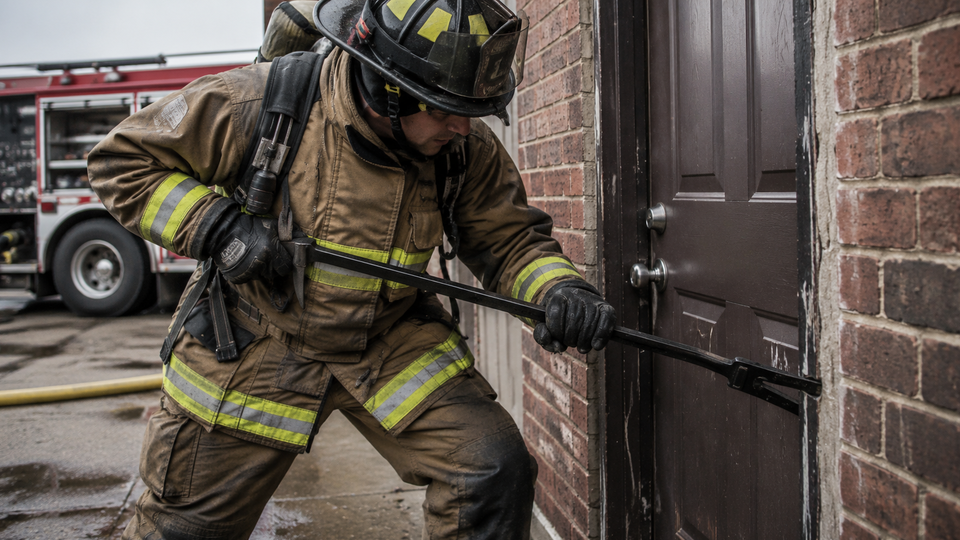
In firefighting terminology, “the irons” are not just a Halligan and an axe sitting in the same compartment. A working set of irons is a Halligan married to a flathead axe so that one firefighter can carry the pair as a unit and deploy both together.
Why the Halligan and Flathead Axe Are Paired
The Halligan handles prying, spreading, punching, and leverage, and the flathead axe brings the striking surface and chopping capability. Together, they give a crew a compact, familiar combination for forcing doors, attacking common barriers, and moving quickly from access to opening-up work.
When you compare fire axes, the key is to look at how the axe pairs with the Halligan you carry. The handle, head profile, and mounting arrangement all decide whether the set rides securely and comes apart cleanly when needed.
Marrying Straps and Carry Method
A marrying strap or carrying system holds the Halligan and flathead together until they are needed. It should be secure enough for apparatus storage and carry, but not so fussy that it slows deployment. Simple, glove-friendly, and repeatable usually beats complicated retention.
Departments also have to decide where the set lives. Cab-mounted irons, compartment-mounted irons, and multiple sets assigned by riding position all build different deployment habits. In response, the placement should support the expected assignment. If the firefighter behind the officer is expected to grab the irons every time, the mounting and retention should make that setup natural.
- Primary irons: Full-size Halligan and flathead axe, staged for the first firefighter assigned to entry.
- Secondary irons: Additional set for a truck company, second-due company, or alternate access point.
- Compact support tools: Mini Halligan, officer tool, or lock tool carried to supplement the main set.
- When putting together a setup, the goal is simple: Train with what you carry. The carried setup should match how your department practices forcing, striking, carrying, and staging.
Firefighter Hooks
Firefighter hooks do more than pull ceiling. The right hook pattern improves reach, control, purchase, and speed during opening-up, overhaul, roof work, wall access, and debris movement. The wrong hook can still work, but it will be slower for the job your company does most.
Columbus Supply carries firefighter hooks (NY, roof, Boston), including options from Fire Hooks Unlimited. The selection question is “Which pattern and length match the assignment?”
NY Hook
The New York hook is one of the most recognized patterns in the fire service. Crews pick it for its versatility in pulling, prying, opening walls, and general truck work. The head design gives firefighters a working profile that can bite, pull, and manipulate material more aggressively than a plain pole end.
An NY hook is a strong choice when a department wants one pattern that covers interior work, overhaul, and general opening-up. Keep in mind that length and handle material still matter. A hook that is too long for the compartment or too awkward for interior movement sees less use, even when the pattern itself is sound.
Roof, Boston, Closet, Plaster, Trash, and Denver-Style Tools
Different hooks solve different access and overhaul problems.
| Hook type | Typical role | Selection cue |
|---|---|---|
| New York hook | General pulling, prying, wall and ceiling work | Strong all-around choice where one hook must cover multiple jobs |
| Roof hook | Roof work, exterior opening-up, aggressive purchase | Consider for truck companies and roof assignments |
| Boston hook | Pulling and opening-up tasks with a distinct head profile | Often driven by department preference and training familiarity |
| Closet hook | Tight interior spaces, small rooms, limited reach areas | Useful where a full-length hook is too awkward |
| Plaster/drywall hook | Interior finish removal and overhaul | Match to common building stock and overhaul needs |
| Trash hook | Moving debris and overhaul material | Good support tool when debris movement is frequent |
| Denver-style tool | Compact pulling, prying, and access support | Best evaluated as a specialty complement, not a universal hook replacement |
Pike Poles
Pike poles are long-handled tools for pulling, pushing, reaching, and opening up material at a distance. They overlap with hooks on some tasks, but they’re not the same. A pike pole earns its place when reach is the deciding factor: ceilings, roofs, exterior materials, and anywhere a firefighter needs to work from a safer or more practical position.
The main factors to consider when choosing a pike pole are handle material, length, head style, and storage. Pike poles get awkward quickly when they are poorly matched to the apparatus, so pick them with compartment layout and deployment in mind.
| Pike pole option | Best fit | Buyer considerations |
|---|---|---|
| Fiberglass pike pole | Departments prioritizing durable, consistent construction and easier maintenance | Evaluate grip, balance, and how the pole mounts on the apparatus |
| Wood pike pole | Crews that prefer traditional feel and feedback | Requires attention to inspection, condition, and department preference |
| Shorter pike pole | Interior movement, tighter spaces, easier compartment fit | Less reach for ceilings, roofs, and exterior work |
| Longer pike pole | Reach, roof work, exterior pulling, high ceilings | Harder to maneuver and store; best matched to clear assignments |
For many departments, the practical answer isn’t a choice between hooks and pike poles. It’s carrying both where the response profile supports it: hooks for controlled pulling and opening-up, pike poles for reach and access. What you want to avoid is filling compartments with long-handled tools that all solve the same problem while leaving gaps in lock work, striking tools, or compact interior access.
If your department is standardizing the long-tool complement, tie that decision to apparatus compartment planning for fire/rescue tools and to the riding positions that actually deploy them.
Other Forcible Entry Tools
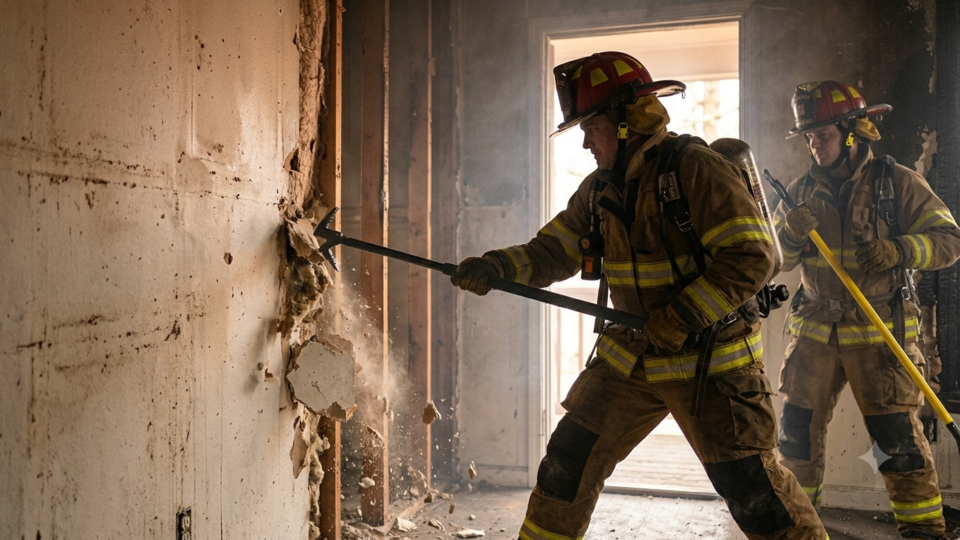
Beyond Halligans, irons, hooks, and pike poles, specialty forcible entry tools solve specific access problems. As a result, they should supplement the core entry complement, not replace basic proficiency with irons, hooks, and reach tools.
K-Tool and J-Tool
K-tools and J-tools go with lock and door hardware work. They are specialty options for situations where manipulating or defeating the lock hardware makes more sense than forcing the whole door assembly with brute leverage.
The question to ask when buying is whether your company runs enough lock-related access work to justify carrying and training on the tool. If you carry it, pair it with the small components and training needed to use it well. A lock tool with no familiarity behind it isn’t a shortcut.
Hux Bar and Kelly Tool
Hux bars and Kelly tools sit in the broader pry-tool family. They appeal to departments that want extra prying, twisting, or leverage options beyond a standard Halligan. If the Halligan already covers the assignment and the crew trains around it, an added pry tool should bring a specific advantage: size, shape, access angle, or compact carry.
These tools have a place in the right complement, but they should solve a problem your irons don’t already solve.
Hydra Ram
A Hydra Ram is a hydraulic forcible entry tool for situations that call for hydraulic spreading force in a compact form. It’s valuable for departments that run into door assemblies where manual prying alone isn’t the preferred approach. It also needs training, maintenance awareness, and storage planning.
The practical question is whether the tool matches your building stock and company tactics. A department with frequent multi-family, commercial, or security-enhanced door problems will weigh it differently than one working mostly light residential construction.
Battering Ram
Battering rams are direct-impact entry tools. They fit law-enforcement-assisted operations, certain fire/rescue access problems, and departments that routinely hit doors where impact entry is appropriate under local procedures. For fire departments, weigh the ram carefully against policy, building conditions, crew staffing, and where it will ride.
Columbus Supply carries battering rams for agencies and departments with a defined use case. A ram is the right tool in the right context, but it’s no substitute for the Halligan-and-axe system most fire companies need first.
Building the Best Setup for Different Applications
The best forcible entry setup is built backwards, starting with the apparatus assignment. A residential-heavy engine, a truck company with roof and overhaul responsibilities, and a volunteer department covering mixed occupancies don’t need identical complements.
Start with the Baseline: Irons, Hook, and Reach
For most companies, the baseline starts with a working set of irons, at least one appropriate hook, and a longer reach tool like a pike pole. This gives the crew a foundation for entry, striking, prying, pulling, and opening up. From there, companies can add specialty capability based on the district.
A practical baseline starts with ensuring the following roles are covered:
- Entry role: Halligan and flathead axe married as irons.
- Opening-up role: Interior hook matched to building stock and compartment layout.
- Reach role: Pike pole or longer hook for ceilings, roof work, or exterior pulling.
- Lock role: K-tool, J-tool, or related hardware tools if lock access is common and trained.
- Impact or specialty role: Ram, Hydra Ram, or alternate pry tool where the department has a defined need.
Engine Company Considerations
An engine company may not need the deepest forcible entry cache, but it does need immediate access. If the first-arriving engine is expected to stretch, force, and start interior work, the entry tools must be reachable and familiar. A reliable set of irons and a manageable hook usually matter more than a compartment full of specialty tools that take time to find.
For engine companies, compactness and predictability are the big buying criteria. A tool mounted in the cab or in a known exterior compartment is worth more than a rarely used specialty tool buried behind other equipment. If staffing is thin, think about how many tools one firefighter can realistically carry along with hose, PPE, radio, and everything else assigned.
Truck Company Considerations
Truck companies generally need deeper coverage: multiple hooks, roof tools, longer pike poles, more irons, and specialty entry tools for commercial doors, overhead doors, gates, and security features. The point is not simply more tools but more distinct capability.
A truck complement might carry different hook patterns for different assignments, a primary and secondary set of irons, longer reach tools, and lock or hydraulic tools. Organization is the the key to a successful run: A firefighter working the roof, the inside team, or the outside vent assignment should know which tool belongs to that role and where it rides.
Volunteer and Combination Department Considerations
Volunteer and combination departments often need versatility and budget discipline. The complement should cover the most likely work first: residential entry, common commercial access, outbuildings, forcible access through gates or locks, and overhaul. This is where professional-grade basics earn their keep. A strong Halligan, a properly paired flathead axe, a useful hook, and a practical pike pole cover a wide range of work when crews train with them consistently.
Where apparatus space is limited, pick specialty tools carefully. A mini Halligan, a compact lock tool, or a specific hook pattern can deliver more day-to-day utility than a larger tool that is hard to carry or mount. The goal isn’t a minimal set. It’s a set that matches your response reality.
Residential, Commercial, and Mixed Districts
Building stock should shape the final complement. Residential areas may reward speed, compact tools, and interior opening-up, but commercial districts require more attention to security doors, gates, overhead doors, locks, and heavier construction. Mixed districts need a balanced set that gives the first-arriving crew options without overwhelming the apparatus layout.
When forced-entry problems shift because of security upgrades, reinforced doors, or unfamiliar lock hardware, review both tools and training. Buying a tool without adjusting training creates a false sense of readiness. In the same way, training without the right tools leaves crews improvising with equipment that may not fit the problem.
Frequently Asked Questions
Frequently Asked Questions
Forcible entry tools for firefighters are built for repeated duty use, gloves, heat, and hard contact on doors, locks, ceilings, and other building components. They’re shaped and balanced for leverage, striking, and pulling in fireground conditions, not just general prying.
A Halligan bar is the individual tool with forks, adze, and pike. A set of irons is the Halligan married to a flathead axe so that the two tools can be carried and deployed together. In practice, the Halligan is one part of the system, while the set of irons is the complete entry package.
There’s no single hook setup that fits every company. Many rigs do best with one general-purpose hook, one longer reach tool, and a pattern chosen for the company’s most common opening-up work. The right mix depends on compartment space, roof responsibilities, and whether the crew needs more interior control or more reach.
A New York hook is typically chosen as a versatile general-purpose hook for pulling, prying, and opening up. Other hook patterns may be better for roof work, confined interiors, or specific overhaul tasks. The difference is less about one hook being universally better and more about which pattern matches the job you do most often.
Not really. They overlap in some pulling and opening-up tasks, but pike poles are usually selected for reach, while firefighter hooks are often chosen for more controlled prying, pulling, and working material in tighter spaces. Many departments carry both because each tool solves a different problem.
Start with the work your company actually performs, then look at tool fit, carry method, storage, and how often the crew trains with it. A tool only earns space if it adds a clear capability or fills a gap in the current complement. If it duplicates another tool without solving a different problem, it’s usually not doing enough for the space it takes up.